The Iris, the Brain, and the Stress Response
Exploring the Relationship Between Brain Flair Reaction Fields and the Limbic System

Beth Hovis
BCDN, CCII-3, BCMH, F.Ir.
IIPA Vice-President
Georgia, USA
Published: October 15, 2026
As Iridologists, we study the iris for indications of constitutional strengths, weaknesses, and patterns that may influence how an individual responds to the demands of life. We learn the locations of reaction fields, recognize different iris signs, and consider how those findings relate to the person sitting in front of us. But as our understanding of human physiology continues to develop, we have an opportunity to look more deeply at the relationships represented on our iris charts.
My research has focused on examining the relationships between the Brain Flair reaction fields, their proposed anatomical and physiological associations, and the neural networks involved in the stress response, particularly those associated with the limbic system.
Understanding how these brain regions communicate and influence autonomic, endocrine, and other physiological functions may provide a broader framework for interpreting traditional Iridology observations and exploring individual patterns of responsiveness.
Understanding the Brain's Response to Stress
Most people associate the limbic system with emotions, and understandably so. Structures such as the amygdala and hippocampus are important in emotional processing, memory, and our responses to experiences. However, their influence extends well beyond what we ordinarily think of as emotion.
The brain continually receives, filters, interprets, and integrates information from our senses, memories, internal physiological conditions, and surrounding environment. The amygdala contributes to recognizing information that may be significant to us, while the hippocampus provides memory and context that can influence how we interpret present circumstances. The prefrontal cortex participates in evaluating information, making decisions, and regulating responses (McEwen & Gianaros, 2010).
These brain regions communicate with the hypothalamus and other regulatory centers that influence the autonomic nervous system and endocrine responses. Consequently, a stressful experience may affect heart rate, blood pressure, breathing, digestion, hormonal activity, and other physiological functions. Communication also occurs in the opposite direction, as changes within the body influence how the brain processes and responds to subsequent experiences (Ulrich-Lai & Herman, 2009).
Consider what happens when someone encounters a situation that reminds them of a previous difficult experience. Their response may begin before they have consciously evaluated everything that is happening. They may notice their heart beating faster, their breathing changing, or their digestive system becoming unsettled. These responses reflect communication among neural networks involved in memory, emotional significance, autonomic regulation, and endocrine activity.
Research has also demonstrated that prolonged or repeated stress can influence the activity and regulation of these networks, affecting both physiological responses and cognitive functioning (McEwen & Gianaros, 2010). Understanding these relationships gives us a broader perspective on how the nervous system responds to the demands placed upon it.
Revisiting the Brain Flair
The Brain Flair has been an important part of my Iridology teaching for many years. Bernard Jensen's descriptions of the physiological reaction fields (1982, pp. 480–489), Ellen Tart-Jensen's anatomical mapping (2004), and Toni Miller's interpretations of light and dark iris signs and their potential physical, mental, and emotional expressions (2016, pp. 236–257) have contributed to the foundation upon which I have developed my teaching and continued research.
Other iridologists have also explored the proposed relationships between cerebral anatomy and iris topography. In his 2006 discussion of cerebral projection areas, Daniele Lo Rito questioned whether the traditional brain sector, located approximately between 11 and 1 o'clock, adequately represented the complexity of the brain. He proposed expanding cerebral topography beyond the conventional Brain Flair region. John Andrews has also addressed the limbic system and its proposed relationships to iridology in his published work, including Emotional Approaches in Iridology (2005). These contributions demonstrate that interest in the relationship between brain anatomy, physiological function, and iris interpretation extends beyond any single mapping tradition.
As I have examined these materials alongside contemporary neuroanatomy, my attention has turned to the relationships among the physiological descriptions, anatomical reaction fields, and neural networks involved in stress regulation. Of particular interest is how the signs and markings within these fields might be considered in relation to an individual's tendencies and patterns of responsiveness.
Within traditional Iridology interpretations, light signs are frequently associated with heightened sensitivity, activity, or reactivity, while dark signs may suggest reduced responsiveness or a different expression of the same underlying tendency (Miller, 2016, pp. 236–257). The interpretation of a particular sign depends upon its location within the iris, the reaction field involved, and the unique characteristics and experiences of the individual.
For example, two individuals may experience similar demands but respond quite differently. One may become restless, mentally active, and physically tense, while another may withdraw, struggle to concentrate, or experience diminished energy. The presence of different iris signs may prompt an Iridologist to explore these contrasting tendencies through observation and conversation.
When we bring an understanding of the limbic system into that discussion, additional questions emerge. How does the brain determine what deserves our attention? How do previous experiences influence present responses? Why does one person respond to pressure with increased activity while another becomes overwhelmed or withdrawn? And how might those responses influence other physiological systems?
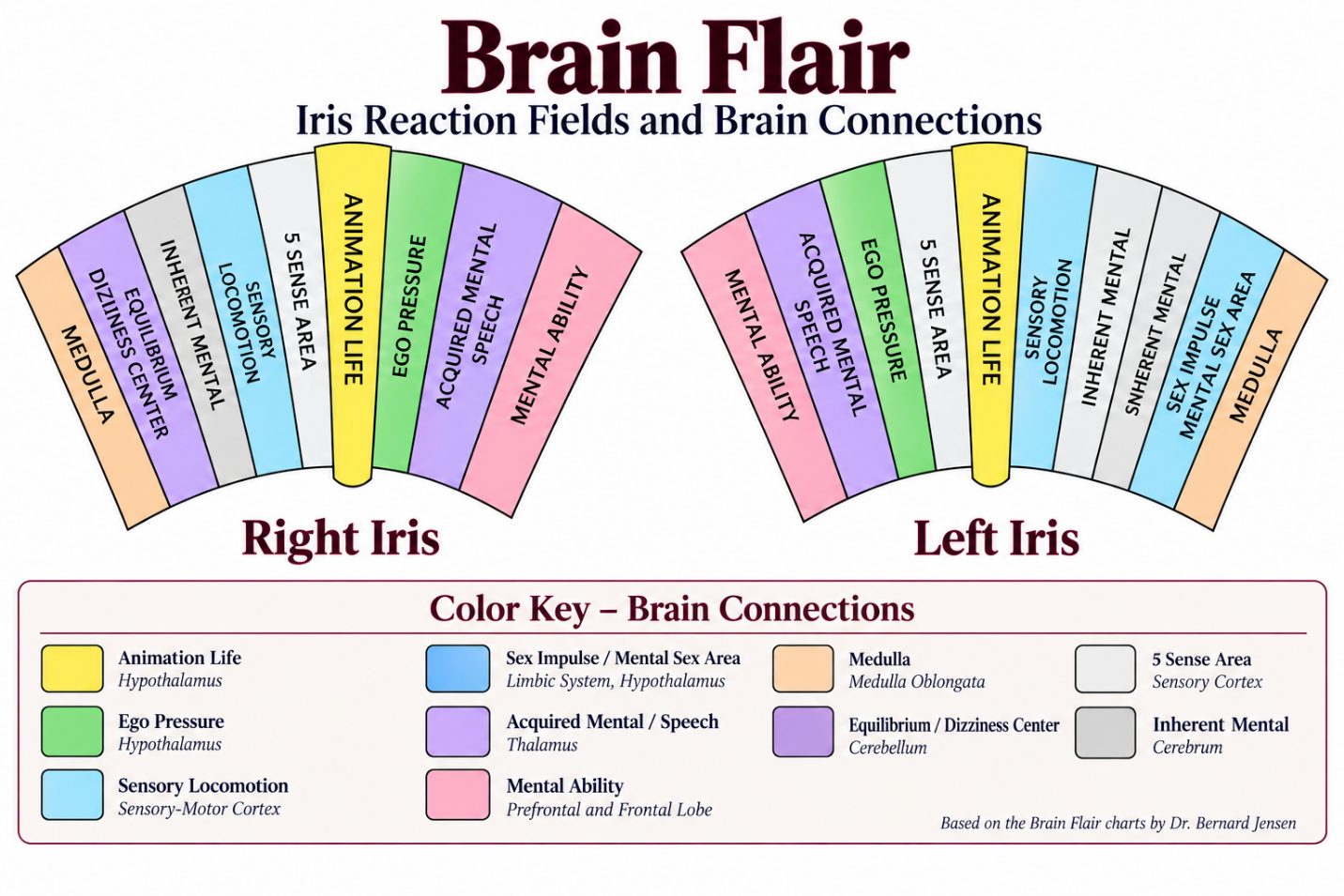
Figure 1. Updated Brain Flair illustration integrating physiological descriptions and anatomical reaction fields. Illustration by Beth Hovis, adapted from Jensen (1982, pp. 480–489) and Tart-Jensen (2004).
Bringing the Connections Together
The limbic system operates through extensive communication with other regions of the brain. These connections are particularly relevant when examining how the nervous system evaluates experiences, coordinates physiological responses, and adapts to ongoing demands.
Consider the frontal brain. The prefrontal cortex participates in attention, working memory, planning, decision-making, and the regulation of responses to stress. Research also identifies its role in coordinating autonomic and endocrine activity through connections with other brain regions (McKlveen et al., 2015).
When examining the Mental Ability and Acquired Mental/Speech reaction fields, an Iridologist may consider how an individual describes concentrating, organizing thoughts, communicating, or making decisions, particularly when under pressure. These observations can lead to questions about sleep, fatigue, emotional responses, and other physiological experiences that may influence cognitive functioning.
The hypothalamus offers another important area of investigation. It participates in regulating body temperature, appetite, sleep-wake rhythms, autonomic activity, and hormonal responses. Its role in coordinating the body's response to stress has been extensively studied, particularly through its connections with the pituitary gland and autonomic nervous system (Ulrich-Lai & Herman, 2009).
Within the Brain Flair framework, areas associated with vitality and pressure invite us to consider these functions in relation to the individual's experiences. Someone describing persistent mental pressure, disrupted sleep, digestive changes, or fluctuations in energy may be experiencing several interconnected physiological responses rather than isolated difficulties.
The amygdala and hippocampus add another dimension. Located within the medial temporal lobes, these structures participate in evaluating significant experiences and incorporating memory and context into our responses. Their connections with the prefrontal cortex, hypothalamus, and other regions help explain why emotional experiences can influence physical responses throughout the body (McEwen & Gianaros, 2010).
For the Iridologist, understanding these relationships creates an opportunity to consider reaction fields that might otherwise be examined individually. We can begin by asking how the functions represented by different fields relate to one another and whether the individual's reported experiences provide additional context for the signs we observe.
The anatomical and physiological connections within the brain are well documented in contemporary neuroscience, while the relationships represented on traditional iris charts arise from a different body of research and clinical observation. My investigation focuses on examining these proposed relationships in light of our expanding understanding of neuroanatomy and physiology, particularly how interconnected brain regions contribute to individual responses to stress.
This approach encourages us to consider the individual's experiences alongside our observations. Two people may respond quite differently to similar circumstances, depending on their previous experiences, physiological condition, and ability to adapt to ongoing demands. The signs and markings within their irises may suggest different tendencies within traditional Iridology interpretation, while their personal histories and descriptions of what they are experiencing provide essential context.
Continuing the Exploration
The relationships between the brain and the physical body are complex. Emotion, memory, sensory processing, hormonal regulation, and autonomic responses are closely interconnected, influencing how we experience and respond to everyday life. Yet these responses are not identical from one person to another. Each individual brings a unique combination of constitutional characteristics, personal experiences, emotional tendencies, and physiological patterns that influence how they perceive and respond to the world around them.
One of the aspects of Iridology I find particularly valuable is the opportunity to explore that individuality. Through constitutional observations, physiological reaction fields, and approaches such as Denny Johnson's Rayid Model of emotional iridology (Johnson & Ness, 1995), we seek to better understand the person behind the iris. Within these interpretive frameworks, the patterns and markings we observe may offer clues about an individual's natural tendencies, sensitivities, strengths, and potential responses to life's demands. This understanding can help us ask more meaningful questions and consider approaches to supporting our clients that respect their individual characteristics rather than assuming everyone responds to stress in the same way.
My ongoing research brings together the Brain Flair foundation I have taught for years with contemporary findings about neural networks involved in stress regulation. It has also led me to consider a broader question: How much of the stress people experience is influenced by the demands they place upon themselves, or that others place upon them, which may be inconsistent with their natural tendencies, values, and sense of identity? When individuals experience persistent fear, pressure, or conflict, the nervous system may remain in a heightened state of vigilance, with physiological consequences that extend throughout the body.
Understanding a person's unique design may therefore have implications beyond recognizing their patterns of stress responsiveness. It may also help us explore what brings that individual a sense of purpose, fulfillment, and well-being, and what circumstances repeatedly place unnecessary demands upon their nervous system. As Iridologists, we have an opportunity to use our observations alongside careful listening and an understanding of physiology to help clients recognize patterns in their lives and consider changes that may better support their overall health.
As our knowledge of the nervous system continues to develop, I believe there is value in examining traditional Iridology concepts through a deeper understanding of anatomy, physiology, and individual identity. Perhaps one of the most meaningful questions we can begin asking is not simply how a person's nervous system responds to stress, but whether the life they are living is allowing them to function according to their unique design.
References
Andrews, J. (2005). Emotional approaches in iridology. John Andrews Iridology. https://www.johnandrewsiridology.net/extrapages/emotional.htm
Jensen, B. (1982). Iridology: The science and practice in the healing arts (Vol. 2). Bernard Jensen International.
Lo Rito, D. (2006). Iridology and Dirk-Hamer syndrome. https://www.iridosophia.com/k-content/iridosophia/themes/iridosophia/html/filebank/iridology-hamer.pdf
McEwen, B. S., & Gianaros, P. J. (2010). Central role of the brain in stress and adaptation: Links to socioeconomic status, health, and disease. Annals of the New York Academy of Sciences, 1186(1), 190–222. https://doi.org/10.1111/j.1749-6632.2009.05331.x
McKlveen, J. M., Myers, B., & Herman, J. P. (2015). The medial prefrontal cortex: Coordinator of autonomic, neuroendocrine and behavioural responses to stress. Journal of Neuroendocrinology, 27(6), 446–456. https://doi.org/10.1111/jne.12272
Miller, T. (2016). The integrated iridology textbook (2nd ed.). Inter Health Aust. Pty Ltd.
Tart-Jensen, E. (2004). Iridology chart [Anatomical iris chart]. Infinity Iris.
Ulrich-Lai, Y. M., & Herman, J. P. (2009). Neural regulation of endocrine and autonomic stress responses. Nature Reviews Neuroscience, 10(6), 397–409. https://doi.org/10.1038/nrn2647
Johnson, D. R., & Ness, J. E. (1995). What the eye reveals (Rev. ed.). Rayid Publications.