MTHFR Gene Variants: Exploring Connections with Iris Pigmentation

Brenda Generalli,
CNC, CCII3
Traditional Naturopath,
Genomic Iridologist
Auburn, California, USA
Published: 09/20/2026
In 2019, I attended the International Iridology Practitioner’s Association (IIPA) Annual Symposium. Dr. Michael Salas spoke about MTHFR. I’d never heard of MTHFR before and thought it might be the answer to my health problems. He conducted studies on patients with brown pigments to determine if there was a connection between brown pigments and MTHFR gene errors. After speaking with Dr. Salas, I decided to hold a 6-month peer review to continue this research. I have found that yellow and orange pigments in both blue-eyed people and mixed-biliary-eyed people are also connected to MTHFR gene errors. So far, all my clients with yellow, orange, or brown pigments (except 2 who have Hematogenic irises) have tested positive for MTHFR gene errors based on blood tests. I want to thank Dr. Salas for all his support and training throughout this process.
What is MTHFR?
MTHFR is the most talked-about gene among health enthusiasts and functional medicine practitioners. It became a popular topic after large-scale studies linked poor methylation with chronic health problems like:
• Cardiovascular diseases (specifically blood clots, stroke, embolism, and heart attacks)
• Depression
• Anxiety
• Bipolar disorder
• Schizophrenia
• Colon cancer
• Acute leukemia
• Chronic pain and fatigue
• Nerve pain
• Migraines
• Recurrent miscarriages in women of child-bearing age
• Pregnancies with neural tube defects, like spina bifida.
Learning about MTHFR is important as it allows you to determine how efficient your body is with the methylation cycle. By understanding this, you’re able to implement lifestyle changes that can help with methylation and increase your quality of life.
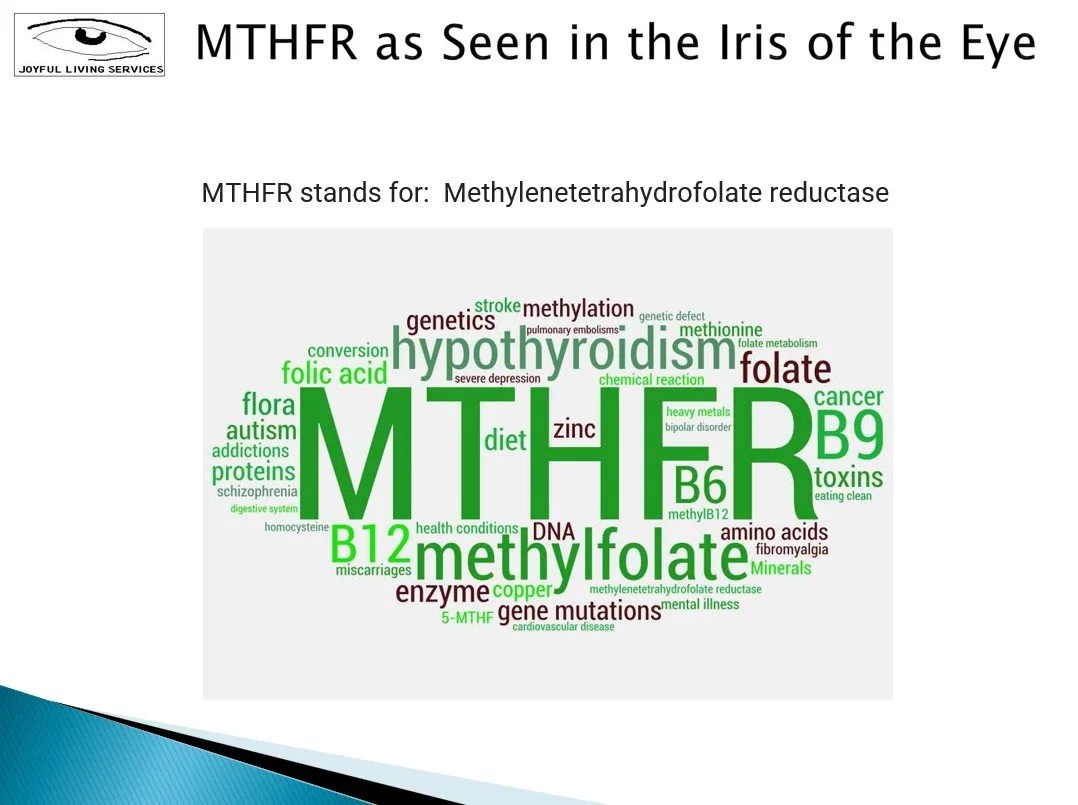
MTHFR stands for: Methylene Tetrahydrofolate Reductase
Methylene Tetrahydrofolate Reductase, or MTHFR, is an enzyme that breaks down the amino acid homocysteine. The MTHFR gene that codes for this enzyme has the potential to mutate, which can either interfere with the enzyme’s ability to function normally or completely inactivate it.
Inheritance
People inherit one copy of the MTHFR gene from each of their parents, so everyone has two MTHFR genes. Mutations can occur in one or both genes. Having a parent or close relative with an MTHFR gene mutation can increase a person’s risk of inheriting the same variant.
Mutations can affect one (heterozygous) or both (homozygous) of these genes.
People who have two parents with mutations have an increased risk of having a homozygous MTHFR mutation.
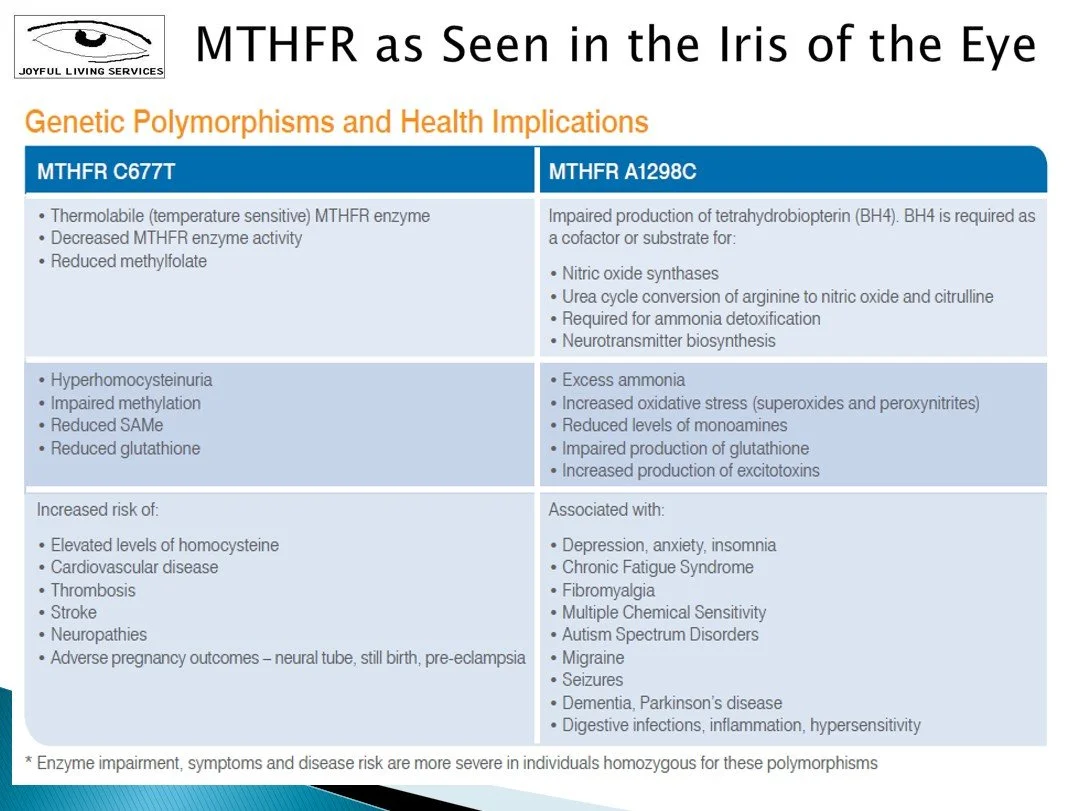
There are two common types, or variants, that we are studying: C677T and A1298C. These mutations can lead to high levels of homocysteine in the blood.
MTHFR C677T
One function of MTHFR (Methylene Tetrahydrofolate Reductase) is to help convert homocysteine to methionine. A MTHFR C677T mutation means that the MTHFR enzyme may have trouble performing its task, leading to high levels of homocysteine.
According to Dr. Ben Lynch, impaired function of the enzyme can cause or contribute to conditions such as autism, chronic fatigue syndrome, fibromyalgia, miscarriages, IBS, many birth defects, multiple sclerosis, Alzheimer’s, bipolar disorder, blood clots, stroke, chemical sensitivity, and many other conditions. MTHFR C677T can also lead to high homocysteine. While homozygous (+/+ double positive) or heterozygous (+/- one positive) mutation indicates reduced activity of this enzyme, it does not necessarily mean there will be high homocysteine levels in a clinical setting.
MTHFR A1298C
MTHFR A1298C is involved in converting 5-methylfolate (5MTHF) to tetrahydrofolate (THF). Unlike MTHFR C677T, the A1298C mutation does not lead to elevated homocysteine levels. This reaction helps generate BH4. BH4 is important for the detoxification of ammonia. The gene is compromised by about 70% in homozygous individuals, and about 30% in people with a heterozygous mutation. BH4 acts as a rate-limiting factor for the production of neurotransmitters and catecholamines, including serotonin, melatonin, dopamine, norepinephrine, and epinephrine. An MTHFR A1298C + status may cause a decrease in any of these neurotransmitters or catecholamines. BH4 is also a cofactor in the production of nitric oxide. A dysfunctional BH4 enzyme may lead to mental/emotional and/or physical symptoms. Mercury, lead, and aluminum may act as a drain on BH4.
What is Homocysteine?
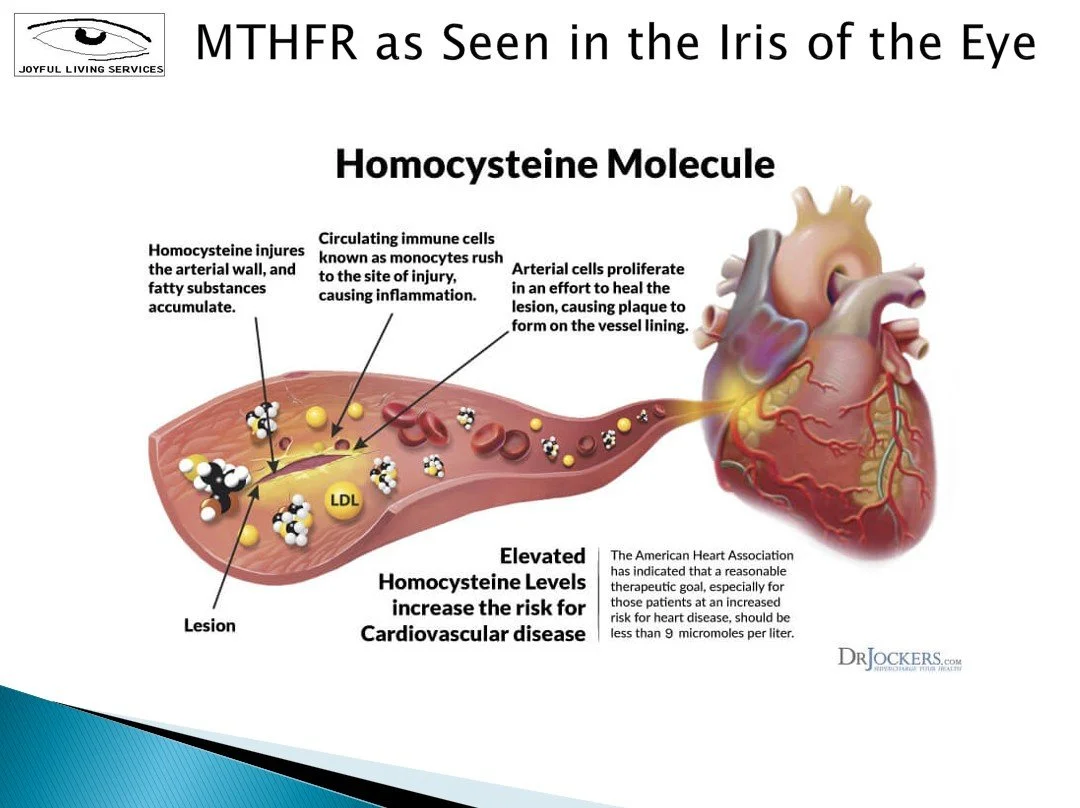
Homocysteine is a sulfur-containing amino acid that the body produces from another amino acid, called methionine.
• Foods that are high in methionine include meat, egg whites, and seafood.
• Homocysteine is usually found in very small amounts in your body. That’s because your body converts it efficiently into other products with the aid of vitamin B.
• Higher homocysteine levels can indicate a deficiency of these vitamins, which have been linked to heart disease, cognitive dysfunction, and dementia.