THE SIGNIFICANCE OF THE HUMAN IRIS IN PSYCHOLOGICAL TERMS

Christos Miliankos
BH Sci-Nat, B.Sc., CCII-3, F.Ir. CSI
IIPA Treasurer
Victoria, Australia
Published: September 15, 2026
Iridology can be a window into our soul. It can enhance our ability to understand our inner world. According to Farida Sharan, the iris is the only brain tissue to meet the outside world. Therefore, the iris reflects the entire life of the whole person, body, mind, and spirit.
Early Iridology focused primarily on verifying physical readings; however, in the last 20 years or so, there has been much attention on the psychological correspondences of signs in the iris.
The correspondences of body organs and emotions are not new, Lindlhar said, “That the ancients understood the connection between diseases of the liver and spleen and emotional conditions is proved by the fact that the word ‘melancholia’ means ‘black gall’."
These days, even in Orthodox Medicine, it is quite accepted that the body and mind affect one another; therefore, it is simply a natural step to correlate iris readings to the appropriate corresponding mental or emotional state.
To look at the iris in psychological terms allows us to see beyond the physical tendencies, predispositions, and toxicity of the iris of old (which of course still holds an important part in Modern Integrated Iridology and treatment protocols), but instead out jumps a real person, with his passions, desires, weakness, and sensitivities. We are able to see the personality of the whole person, the type of advice that would be best for them, the type of treatment that would not only help their body to heal itself but also to nourish their mind and soul. It is here that we truly see the power of the word. For example, just acknowledging that a person has a Ring of Harmony (rather than a lymphatic rosary, which accounts for their blocked-up mucous persona), and is the type of person who wants to keep the peace, avoids conflict, and is so sensitive that they feel others’ pain, actually empowers them to be themselves, achieve balance, and live to their highest potential. Possibly for people with a Ring of Harmony singing lessons, finding their own voice and learning to say ‘no’ will be a lot more effective than using Hydrastis candensis (Golden Seal) alone.
Carl Jung said, “In the same way that the conscious and unconscious are in constant action, the body and mind are in constant interaction." Every little thought or feeling that we have has a physical reaction, therefore seeing the iris in both physical and emotional terms can only be empowering and healing for the whole person. It helps them understand themselves and strive to reach their highest potential. This can only lead to more happiness and peace in our families and the whole world.
SOFT INDISTINCT SCLERA/CILIARY EDGE
On the physical level, this sign is seen as a sign of reduced circulation and lowered energy levels.
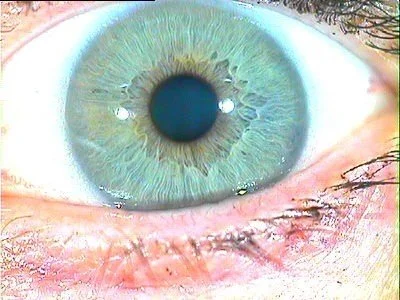
However, on an emotional level these people are often referred to as ‘chameleons’ – they are easy going and relaxed in social situations. They adapt to others’ needs. To the lonely they can be a listener; to the lively they can be a groover.
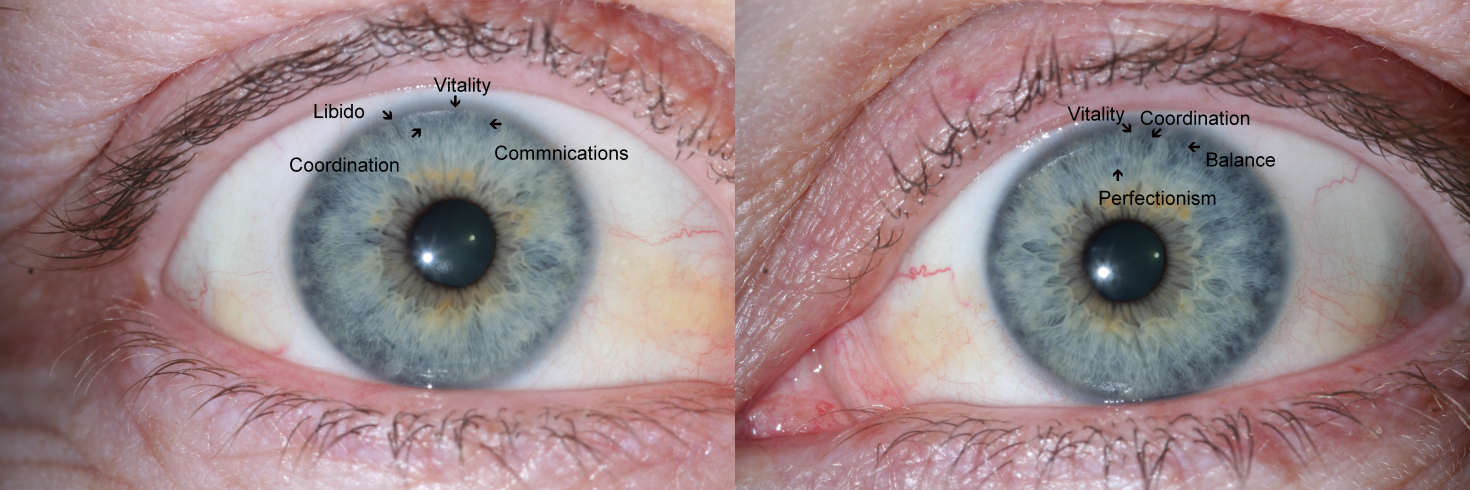
LIBIDO ZONE MARKINGS
Markings in the Libido Zone of the iris suggest symptoms ranging from sexual disinterest or repulsion, obsessions or perversion (this depends on the degree of darkness in the mark). This can sometimes be traced back to negative sexual experiences. Psychologically, light markings can indicate a person who is confident, alert, with well-developed instincts and a good survival sense. Dark markings often indicate attitudes such as envy, self-indulgence, apathy, and indifference.
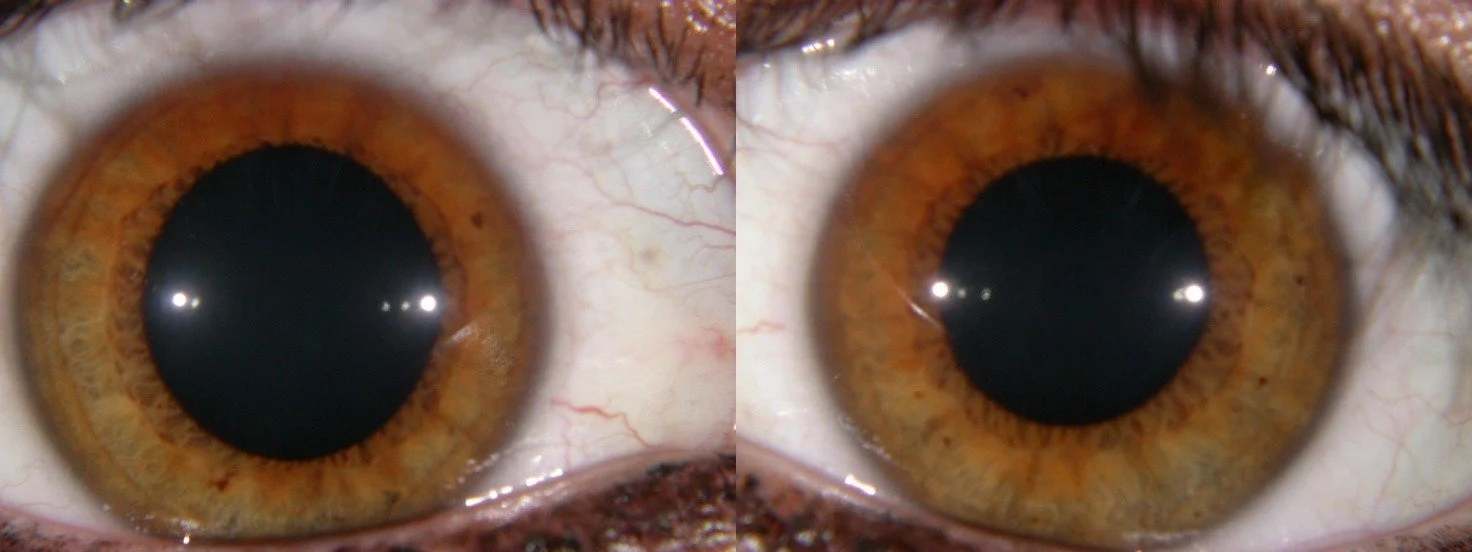
MYDRIASIS
Mydriasis is identified by a pupil that is abnormally large relative to the amount of light intensity. People with this sign in their iris are often familial, generous, and easy to approach. They are enthusiastic and are suited to careers where they have to deal with people.
These people have a soft nature and often complain of being overwhelmed and burdened. They have well-developed intuition, though often use expressions such as “Just can’t take it anymore” and “All too much for me”.
ATONIC COLLARETTE
A person with an atonic collarette normally places more emphasis on quantity rather than quality, and this often leads to poor food choices. These people tend to be extroverted and materialistic, and some would describe them as an ‘open book’. This often leads them to be careless with confidences. They need to learn discretion.